
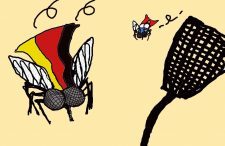
Every language has expressions that resist translation, and that make little sense even once translated. When you learn German in the City of London these are not necessarily what you are taught, but they are what you will meet the moment you socialise in Germany. Here are seven, with what each one means in English and, where it is known, where it came from.
“Lügen haben kurze Beine” — meaning in English
Lies have short legs. Deception might get you out of trouble in the short term, but short legs do not carry you far, and sooner or later it catches up with you. Versions of the same proverb turn up across Europe, which suggests it is very old.
“Ich drücke dir die Daumen” — meaning and when to use it
I press the thumbs for you. Where an English speaker crosses their fingers, a German folds the thumb inside the fist and squeezes, and will often show you the fist as they say it. It is said to go back to the idea that the thumb held a spirit that could be kept in check by holding it down. Say it to a colleague before an interview or a presentation.
“Es ist mir Wurst” — meaning in English
It is sausage to me. Given two or more options and no preference between them, this is how you say you do not mind either way. The usual explanation is that a sausage looks the same whichever end you start from, so the choice makes no difference.
“Hopfen und Malz ist verloren” — meaning and origin
Hops and malt are lost. There would have to be a beer-related idiom in German. When something goes wrong during brewing, the ingredients are good for nothing and the batch cannot be rescued. Said of a lost cause, and usually with a shrug.
“Schwein haben” — meaning and origin
To have a pig. You would not think of a pig as fortunate, least of all in Germany, where it is a staple of the diet — but it is also a sign of luck. The phrase is generally traced to medieval contests where whoever finished last was handed a pig as a consolation prize, and so went home with something after all. If you have a piece of unearned good fortune, you had a pig.
“Nicht alle Tassen im Schrank haben” — meaning in English
Not to have all the cups in the cupboard. English offers a wide choice here — he is not all there, he has lost his marbles, he is a sandwich short of a picnic. One suggested origin has nothing to do with crockery at all: the Yiddish toschia, meaning sense or understanding, reinterpreted by German speakers as Tassen.
“Ich habe die Nase voll” — meaning in English
I have the full nose. Not a request for a tissue, but a statement that someone has had quite enough of a particular situation. The closest English is I have had a bellyful of it. Note that adding gestrichen — ich habe die Nase gestrichen voll — makes it considerably stronger.
Do you recognise the idiom in the picture at the top of the page?
More German idioms
There are three further collections on this site: idioms built on clothing, idioms drawn from animals and food, and five idioms for working life.